Discover Non‑invasive Regenerative Medicine:
It is a concept of deep hyperthermia, totally different from conventional and classical thermotherapy that heats the tissues only superficially. Medestec® technology is a radiofrequency system that, through an electric current, produces biostimulation of the tissues, generating vasodilation that helps the body’s natural regeneration.
Medestec® diathermy aims to achieve an immediate reduction of inflammation and pain, speeding up the tissue’s natural mechanisms so that the patient recovers as soon as possible. Medestec helps the fast rehabilitation of athletes and injured patients who need to return quickly to their activity.
Medestec® Diathermy is so effective that results begin to be noticeable from the first session. Inflammation and pain decrease progressively and, depending on the injury, the number of required sessions ranges from 3 to 5, or up to 10 for more severe injuries, with a key change usually appearing between the 4th and 6th session.
Medestec® diathermy produces a vasodilator effect that activates blood circulation, nourishing and revitalising the cells, improving skin tone and elasticity, reducing fat and producing significant changes in skin hydration.
Improvement can be noticed from the first session, since the immediate effect of diathermy is collagen retraction, which ensures tissue toning. It also allows greater effectiveness in cosmetic treatments because, thanks to its pore‑dilating effect, products penetrate more deeply.
Shock waves are a physical therapy technology that uses high‑energy acoustic waves to stimulate tissues in depth, in a very different way from massage or classic superficial thermotherapy. Through an applicator placed on the skin, these sound waves are transmitted to the injured tissue, where they generate controlled mechanical micro‑stimuli that activate circulation, a “positive” inflammatory response and the body’s natural cellular repair processes. This biostimulation helps reduce pain and improve regeneration in tendinopathies, calcifications or chronic muscle injuries, shortening recovery times without invasive procedures.
Shock waves are a widely used tool in sports physiotherapy because they greatly shorten recovery times and help athletes return to activity earlier and more safely. Applied in controlled phases of the injury and directed to the injured area, they reduce pain, stimulate circulation and promote repair of damaged tissue. They are especially useful in tendinopathies, muscle overloads or overuse injuries, where their effectiveness often makes it possible to avoid injections or more aggressive procedures. With a correctly designed treatment plan and the minimum number of sessions, usually between 3 and 5 and up to 8–10 in more complex or chronic cases, the sports physiotherapist always determines the exact schedule.
Shock waves help speed up the recovery of workers and professionals with musculoskeletal injuries caused by repetitive movements, lifting loads or many hours sitting, helping them return to work sooner with less pain.
The application of high‑energy acoustic waves produces a revascularisation and biostimulation effect in the tissues, which activates blood circulation, improves oxygenation, reduces inflammation and promotes the natural repair of tendons, muscles and bones, resulting in less discomfort and greater functional capacity in daily life.
Improvement is usually noticeable from the first sessions, with progressive pain reduction and greater tolerance to effort.
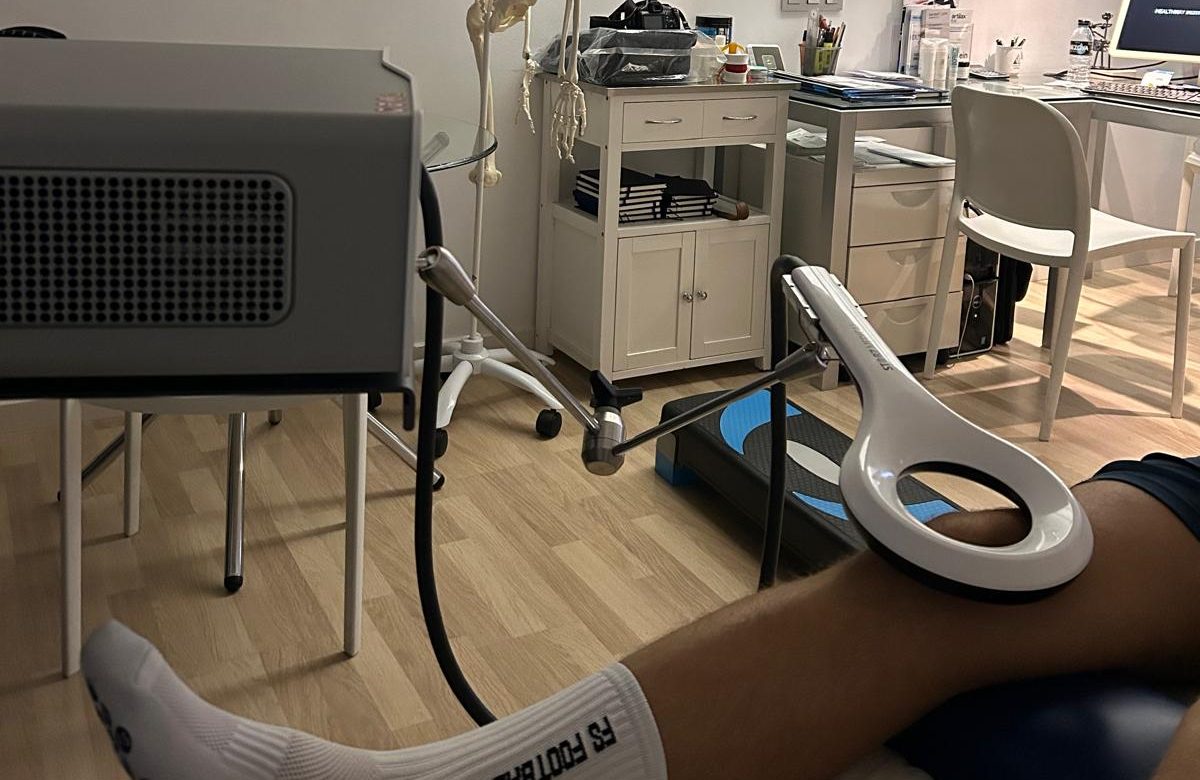
Magnetolith is an extracorporeal magnetotransduction technology (EMTT) that applies pulsed electromagnetic fields of high frequency and intensity to stimulate tissues in depth, up to several centimetres, without direct contact or invasive procedures. These impulses activate biological processes such as tissue regeneration, formation of new blood vessels and modulation of inflammation, which helps reduce pain, improve mobility and speed up recovery in musculoskeletal injuries, arthrosis and sports injuries. Sessions are short, comfortable and practically painless, and many patients notice a progressive improvement in pain and function after just a few sessions, especially when included in a broader physiotherapy and rehabilitation plan.
No, Magnetolith is considered a non‑invasive and very well‑tolerated treatment, with no needles or injections. During the session you may feel a slight vibration or internal sensation in the treated area, but it is not usually painful and, afterwards, you can resume your normal activities without recovery time.
The number of sessions depends on the type and progression of the injury, but treatment cycles of 8 to 10 sessions of about 15–30 minutes each are usually recommended, adjusted by the physiotherapist. In many cases, patients begin to notice reduced pain and better mobility after the first sessions, with clearer improvement as the full protocol progresses.
At Healthway Institute we offer you a wide range of treatments:
According to the World Health Organization, physiotherapists assess, plan and carry out rehabilitation programs (treatment) to improve and restore motor functions, maximize movement, relieve painful syndromes, and treat and prevent physical disorders associated with diseases, injuries and other disabilities.
The WCPT (World Confederation for Physical Therapy) states that Physiotherapy involves interaction between the physiotherapist, patients/clients, other health professionals, families, carers and communities.
Physiotherapists aim to maximise quality of life in promotion, prevention and treatment, considering the four dimensions of the human being: physical, psychological, social and ethical/spiritual.
They are qualified to carry out a comprehensive Physiotherapy examination/assessment, analyse the results, formulate a diagnosis, prognosis and Physiotherapy plan, implement the treatment programme, determine outcomes and decide when referral to other professionals is needed.
From Healthway Institute we apply a wide range of techniques, such as movement and physical means.
We also develop and implement programmes for the prevention and detection of common diseases and physical disorders.
Physiotherapists make recommendations on health promotion and self‑care for patients to prevent future injuries and improve day‑to‑day well‑being.
It is a recognised and well‑established system of manual medicine for diagnosis and treatment, whose main interest lies in the structural and functional integrity of the body. Due to its Anglo‑Saxon origin (osteo + path), we can define it as the path that seeks balance between any part of the body and its function.
At the European School of Osteopathy in Maidstone (England), a world reference in osteopathy training, I was able to understand the intimate relationship between science and philosophy in osteopathy, which changed my perception of health and disease.
As Dr. Still postulated, I understand the organism as a unit that includes mechanisms of self‑regulation and self‑healing, where structure governs function.
Therefore, I do not consider osteopathy an alternative to conventional medicine, but rather a complementary discipline.
What does not move alters correct functioning and causes problems that often appear far from the real place of pain. We treat the cause, not just the symptom.
Considering that each patient is a world of their own, it is important to be able to help them so that their body reaches its optimal operating state, so that they can feel better about themselves and enjoy better health in our hands.
The osteopath should be a healthcare professional with a university degree in Health Sciences plus a Master’s or Postgraduate degree in Osteopathy, meeting the criteria required by the E.F.O. (European Federation of Osteopaths).
In the USA, osteopathy is a university medical discipline; in Great Britain and some EU countries it is fully legalised as an independent and specific profession.
But the reality in Spain is that there is great intrusion because there is no official regulation, so the healthcare professional who is a physiotherapist with solid osteopathy training is the one most capable and academically prepared to practise osteopathy in this country.
In the last two decades, osteopathy has spread widely throughout Europe, not only as a therapy for the benefit of patients in clinics, but also at university level.
This growth has led to the creation of specialties such as paediatric, obstetric‑gynaecological and sports osteopathy, still without official academic regulation but consolidated through ongoing training of osteopaths and their daily clinical practice.